

BS 9990 Compliance
l
Nationwide UK Coverage
l
Dry Riser Testing
l
Fast Site Surveys
l
Excellent Client Relationships
l
BS 9990 Compliance l Nationwide UK Coverage l Dry Riser Testing l Fast Site Surveys l Excellent Client Relationships l
Dry Risers Explained: Requirements, Components & Maintenance
Dry risers are key components of fire safety in high-rise and multi-storey buildings. A dry riser system is a vertical pipe system installed within a building to help deliver firefighting water from ground level up to higher floors if a fire breaks out. Unlike wet risers, which are permanently filled with water, dry risers remain empty until firefighters connect their hoses to the inlet and pump water through them. During an emergency, fire crews attach hoses to the breeching inlet at ground level, forcing water up the riser to outlet valves on upper floors. This built-in dry riser system ensures water can reach each floor quickly, without firefighters having to carry heavy hoses up stairwells.
When Are Dry Risers Required?
Dry risers are typically required by UK fire safety regulations in tall buildings. Approved Document B (Fire Safety) of the Building Regulations mandates a permanent dry riser system in most buildings over 18 metres tall. Above 50m, however, a wet riser is generally needed because a fire engine’s pump cannot reliably deliver sufficient pressure at that height.
The local Fire Officer and Building Control ultimately determine whether a dry riser is required for a project. The final decision should always be based on the building’s fire strategy, with the dry riser installation designed and installed in accordance with BS 9990:2015, the latest British Standard. Even in some lower-rise or remote-access buildings, a dry riser may be specified if firefighters need a secure water supply where access is limited.
Key Sectors for Dry Riser Systems
Dry risers are used in all occupied buildings where height or design prevents hoses from reaching upper levels. In practice, this covers a wide range of sectors and facilities, each with specific needs. Below are the principal sectors where dry risers are installed.
High-Rise Residential Developments
Tall apartment blocks, high-rise flats and multi-occupancy residential towers commonly require dry risers. In modern cities many new housing developments exceed 18-metres, so dry risers are installed in stair cores or protected lobbies/communal areas to serve every floor, that usually includes the basement level. These systems ensure that firefighters can supply water to upper floors quickly, reducing fire spread. All installations in residential buildings must meet BS 9990:2015 standards and should be certified for compliance.
Office, Retail and Industrial Developments
Multi-storey office blocks, shopping centres, retail parks and even industrial facilities (like factories or warehouses with multiple floors) fall under dry riser requirements. Any commercial building over 18-metres high is mandated to have a dry riser. Large retail complexes and offices often have landing valves on each floor. Industrial sites with tall structures (for example multi-level warehouses) also rely on dry risers. Using dry risers in commercial buildings ensures compliance with fire regulations and keeps insurance valid.
Hospitality and Entertainment Venues
Hotels, conference centres, cinemas, theatres and large entertainment venues such as stadiums typically span several floors or mezzanine levels. These buildings often exceed height thresholds of 18-meters for dry risers.
Hospitals, care homes and other healthcare buildings nearly always install dry risers if they have three or more storeys, due to the vulnerable occupants. Emergency departments and patient wards on upper floors need swift fire response. In practice, every large hospital tower or medical centre uses dry riser systems to meet fire safety regulations.
Transport Hubs and Car Parks
Airports, train stations and multi-storey car parks commonly have dry risers. Major transport terminals are usually large buildings with high ceilings and mezzanines; dry risers ensure water reaches upper platforms. Airports use dry risers to serve multi-level departure lounges and towers. Multi-storey car parks (often open) also require dry risers if they exceed 18-metres, so fire engines can pump water into the parking levels.
Education & Public Buildings
Universities, schools, museums and libraries are often multi-level or have high-ceiling halls. Educational campuses with academic blocks install dry risers as part of fire safety plans. Dry riser systems ensure that venues (for example, a university campus or city hall) have the infrastructure for effective firefighting on upper levels.
Heritage & Cultural Sites
Some historic or listed buildings (Grade I and II) also employ dry risers when they exceed height limits, even if they have architectural constraints. The ability to deliver water internally is crucial for protecting heritage sites like castles and cathedrals that have multiple storeys or attic spaces. The Dry Riser One team notes that dry risers can be installed in “Grade I and Grade II listed buildings” and other protected structures. This means that even an old stone church with a high roof or a grand civic building can have a dry riser added in a sympathetic way, allowing fire brigades to combat fires without relying on fragile historic structures.
Step-by-Step Process for a Dry Riser System
-

Enquiry and Quotation
We discuss your building’s fire safety needs and review any available plans. Based on this, we provide a detailed quote for design and installation.
-

Site Survey and Design
A qualified engineer or Contracts manager surveys the site, confirming measurements and value of materials. If instructed, we then produce a BS 9990:2015 -compliant design, locating the inlet, pipes and outlets per the fire strategy. This design is submitted to the local Fire Authority for approval as required.
-
Installation and Testing
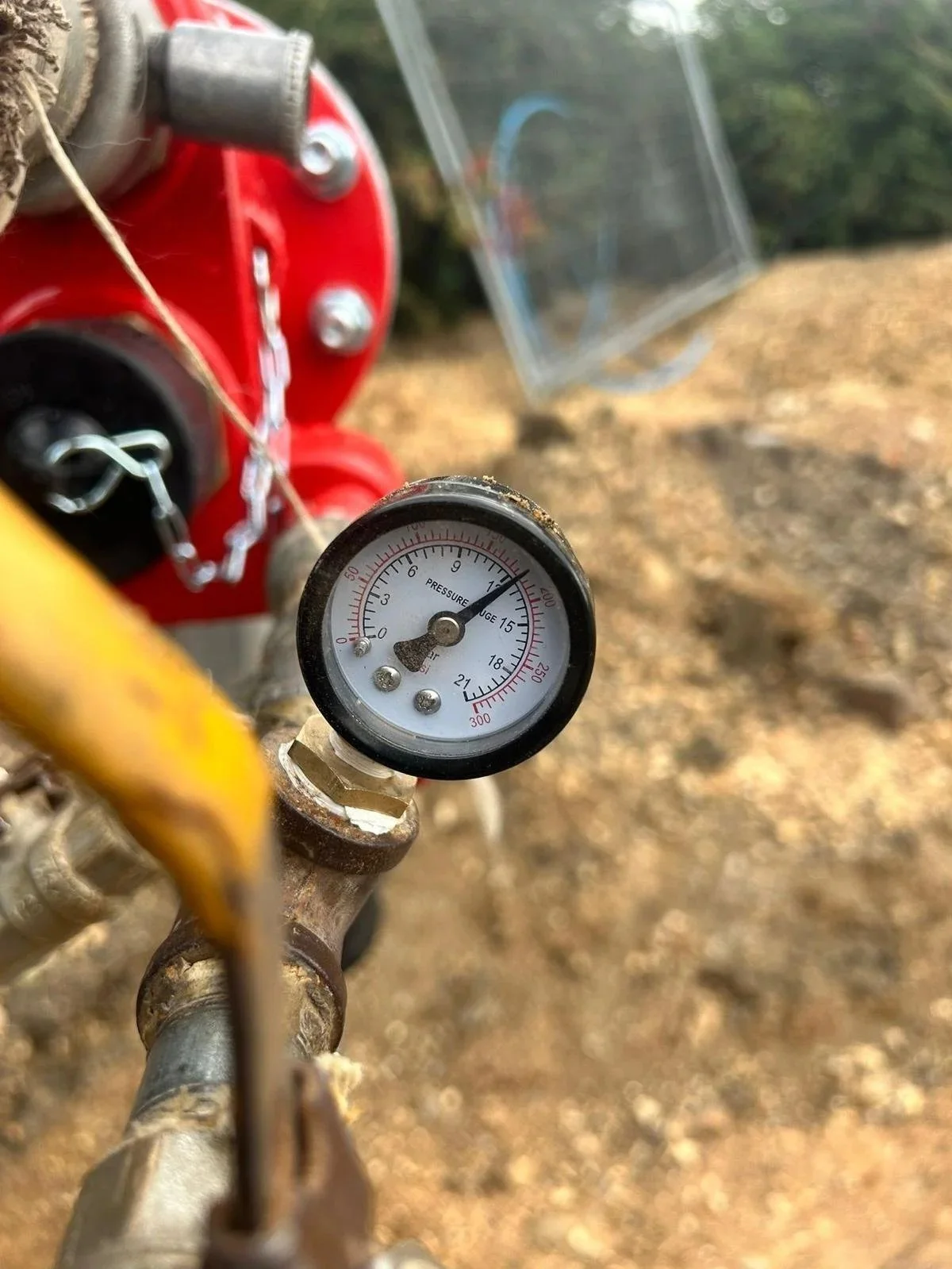
Our trained engineers fit the system according to the approved design. Once assembled, the dry riser is charged with water and pressurised to 12 bar for at least 15 minutes. We monitor the pressure to verify there are no leaks in the pipework, joints or valves. Any defects found are corrected immediately.
-

Handover and Certification
After a successful test, we hand over the system to you along with full documentation. A Certificate of Compliance is issued, confirming that the installation meets BS 9990:2015 standards. This certificate is valid for 12 months, during which a visual inspection is required at 6 months to ensure continued compliance.
Final Acceptance:
We complete the formal handover by ensuring all job sheets and certifications are signed off and a permanent record of the installation is created. Throughout the dry riser installation, all work is carried out by fully vetted, competent engineers. Each team is led by a supervisor with CSCS and SSSTS certifications, and every engineer holds relevant health & safety qualifications. Our staff undergo annual re-vetting and ongoing training (asbestos awareness, working at height, etc.) to maintain the highest standards.
BS 9990:2015 Compliance: All dry riser installations in the UK must comply with BS 9990:2015 – Code of practice for non-automatic firefighting systems in buildings. Key requirements include:
Inlet Location & Cabinet: Install the breeching inlet within 18 metres of the fire appliance access point. The inlet cabinet (BS 5041 Part 5 compliant) should be mounted with its bottom edge 400–600mm from the finished floor level.
Pipework & Layout: Use galvanised steel pipework rated for 12 bar pressure minimum. The horizontal run between the inlet and the vertical riser should be kept to a minimum; typically it must not exceed 18-metres without Fire Officer approval. Horizontal sections must slope back to the drain to avoid standing water.
Outlet Valve Placement: Fit a landing valve at each floor. The centre of each valve should be about 800mm above the floor. Outlets must meet BS 5041 Part 2 standards.
Bespoke Dry Riser Systems: Some buildings have complex layouts or special requirements that call for custom dry riser solutions. Examples of bespoke dry riser systems may include:
4 - Way Outlet: Large developments or mixed-use projects may benefit from a 4-way dry riser outlet (using a “pitcher tee” configuration) to provide multiple hose connections and improve water distribution. Bespoke systems are often needed in listed buildings (where pipes must route around historical features) or in timber structures (where minimal wall penetrations are desired).
Aesthetic Enhancements: This includes powder-coated pipework and cabinets. Powder coating provides a durable finish (with added corrosion resistance) so the system blends with the building’s interior and exterior design. Despite these custom features, every bespoke dry riser still fully complies with BS 9990:2015. For instance, we still position the inlet within 18-meters of the fire appliance and keep any horizontal run to 18-meters or less. As with any system, we conduct the standard 12-bar pressure test and issue a compliance certificate once the installation is complete. In short, you get a tailored system that meets your building’s needs without sacrificing safety or regulations.
Dry Riser Components
A compliant dry riser installation includes several key components, all meeting British Standard requirements. These typically include:
External Breeching Inlet
For a standard 100mm system this is a two-way inlet; larger systems (150mm) use a four-way inlet. Each breeching inlet must conform to BS 5041-3 and be housed in an BS 5041-5 cabinet, with the bottom edge of the door positioned 400–600mm from the finished floor level. The inlet should be within 18-metres of the fire appliance for easy access. 2-Way & 4-Way type breeching inlets have to be designed, constructed and manufactured in accordance with BS 5041 Part 3:1975.
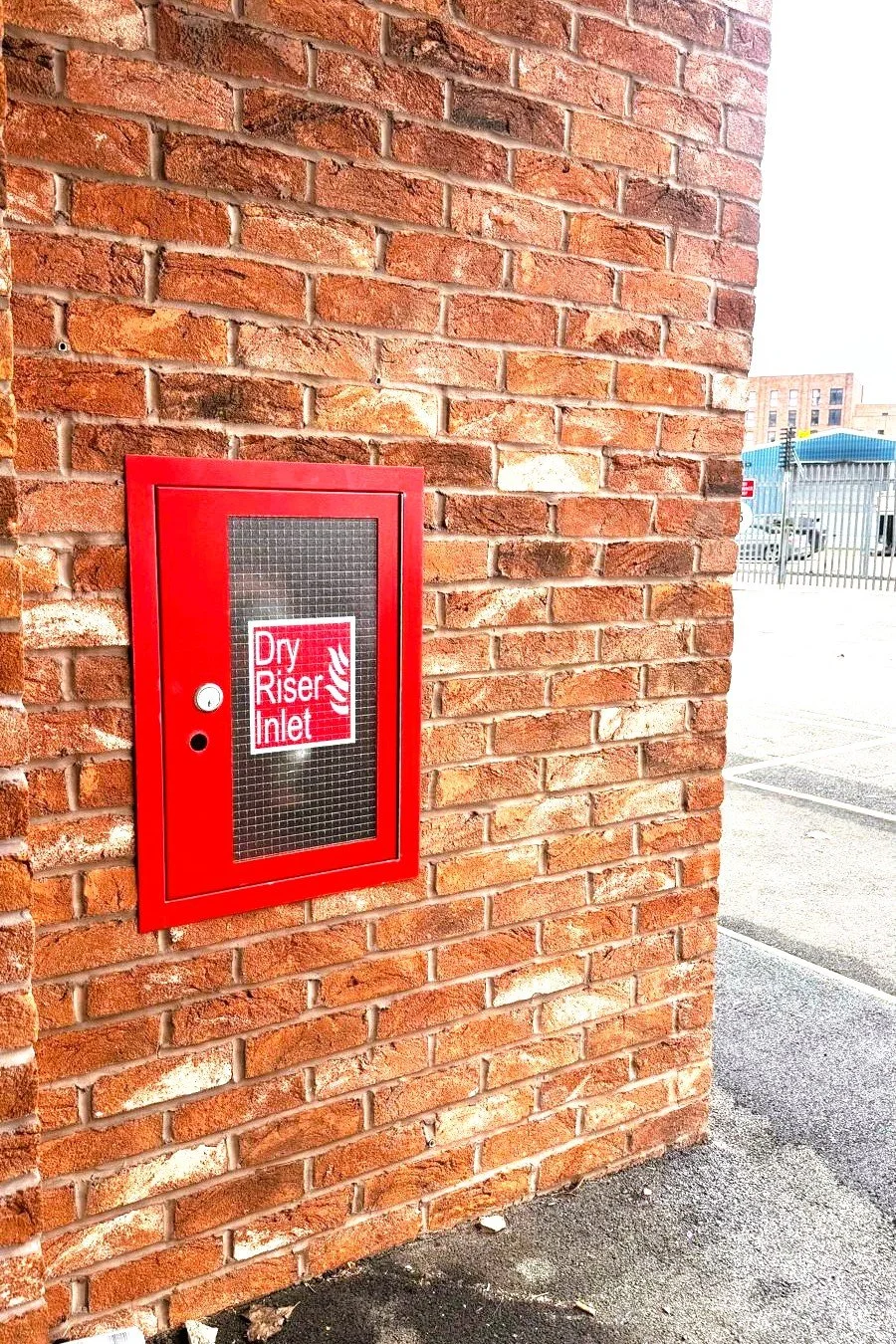
Dry Riser Vertical Inlet Full Cabinet
Vertical inlet cabinets are designed to be recessed into the wall, providing easy access to the inlet breeching valve. The cabinet includes a 38mm surrounding flange and is available in red RAL 3002 or stainless steel finish. The cabinets have a wired Georgian glass door complete with a slam shut lock and stainless steel piano hinge as part of BS 5041 Part 5:1975.
Outlet Valves
Outlet valves shall be installed on every floor, including the ground floor and any basement levels, where applicable. Landing valves should comply with BS 5041 Part 2: 1975 and are usually flanged for ease of maintenance.
Dry Riser Vertical Outlet Architrave and Doors
Outlet valves are housed with lockable outlet red architraves and doors as part of BS 5041 Part 4:1975 to protect them from damage or unauthorised use and are designed to be recessed into the wall for easy access to the dry riser outlet valve. Architrave doors are painted with RAL 3002 powder paint and have a wired Georgian glass door complete with a slam shut lock and stainless steel piano hinge. Each cabinet is clearly marked with “Dry Riser Outlet” sticker.
Galvanised Steel Pipework
The vertical and any necessary horizontal runs are made of galvanised steel. Pipe sections (usually 3.2m lengths) are grooved and fitted with couplings.
Grooved Rigid Couplings
Dry Riser 4” grooved couplings are used to connect pipes in grooved piping systems. They fit securely around the pipe grooves to hold the pipes in place and prevent movement. A gasket inside the coupling creates a tight seal to stop leaks. Standard rigid couplings are used when the pipework is not expected to move.
Air Release Valves
Automatic air release valves are installed at the top of each vertical section to vent air when the riser is charged with water. This component is essential for safe testing and to prevent airlocks.
Drain Valves
Drain valves are a vital part of any dry riser system and are used to drain all of the water from the system after use.
Signage and Identification
All inlets, outlets and associated cabinets must carry permanent signage. “Dry Riser” identification signs are fixed to the equipment in accordance with Health and Safety (Safety Signs and Signals) Regulations 1996 and BS 5499 Part 2. This ensures firefighters can quickly locate and operate the system during an emergency. If the dry riser outlet valves have been left exposed, the signage must have signage on the system itself or next to the outlet valve.
BS 9990:2015–compliant dry riser installation for new builds and existing structures.

Advantages of Dry Riser Systems
Dry risers offer several benefits over alternative fire suppression systems. They are generally more cost-effective and less invasive than full sprinkler installations. Because a dry riser is empty until activated, there is no risk of water damage from leaks in normal conditions. Dry risers are typically located inside stairwells or service shafts, keeping the building’s interior largely unobstructed. In an emergency, firefighters can rapidly deliver water to any floor without running hoses through corridors. Overall, dry riser systems provide a practical way of getting water to the fire quickly, which is why they are widely used in high-rise construction.
Health and Safety Standards at
Dry Riser One Ltd
Dry Riser One Ltd recognises that health and safety does not stand alone. Our Health & Safety Policy links directly with a range of supporting company policies designed to protect people, the public and the environment. These include our Occupational Health Policy, Environmental Policy, Equality and Diversity Policy, Modern Slavery and Human Trafficking Statement, Safeguarding Policy, Drug and Alcohol Policy, Health and Wellbeing Policy, Quality Policy, Anti-Bribery and Anti-Corruption Policy. These policies work together to support safe working practices, ethical behaviour, legal compliance and responsible site operations. All policies are issued to staff and contractors where relevant, are included within our employee documentation and are reviewed at least annually to ensure they remain current, applicable and aligned with our values.
Dry Riser One Ltd is committed to ensuring the health, safety and welfare of all persons affected by our activities, including employees, contractors, clients (Tier 1 contractors) and members of the public.
We recognise our responsibilities under the Health and Safety at Work Act 1974 and all associated legislation, and we will take all reasonably practicable steps to prevent injury, ill health and damage arising from our work activities.
Why Choose
Dry Riser One Ltd?
We are dedicated dry riser specialists with many years of experience. Our expert teams combine technical knowledge with clear communication, guiding you through every step from design to handover. All our installations use high-quality, approved materials and are built to last. Crucially, we ensure every dry riser system is fully compliant.
Fast Response, Fully Certified Engineers, Nationwide UK Coverage, BS 9990:2015 Compliance Specialists.
Dry Riser One Ltd provides professional dry riser installation services for residential, commercial, industrial, healthcare, education, hospitality and public buildings. Our experienced engineers design and install dry riser systems in line with BS 9990:2015 requirements, helping property owners, developers, contractors and facilities managers meet fire safety regulations.
When you work with Dry Riser One, you benefit from a professional service that prioritises safety and reliability. We provide prompt quotes, thorough site surveys and robust designs. Our engineers are CSCS and SSSTS qualified, and we hold all necessary health-and-safety accreditation. The result is a dry riser system that not only meets current regulations but is also easy to maintain and ready to perform in an emergency.
Give us a call on 0800 061 4111 or email our Team at enquiries@dryriserone.co.uk